Jackery Explorer 1000 v2 vs EcoFlow DELTA 3: Full Spec Sheet
This article contains affiliate links: if you buy through them, we earn a small commission at no extra cost to you. It never changes our verdict — our research method is public. See how we research
Search “Jackery Explorer 1000 v2 vs EcoFlow DELTA 3” and the results are a pile of auto-generated spec tables, half of them quietly comparing the Jackery against the DELTA 3 Plus instead of the base DELTA 3 — a different, pricier unit with its own numbers. I checked a dozen of these pages while researching this piece. The capacity figures agreed. The output, the UPS switchover time, and the expansion claims didn’t, because three different sources were describing three different products as if they were one.
So let’s fix that. I’m comparing the standard Jackery Explorer 1000 v2 against the standard EcoFlow DELTA 3 — not the Plus — using each brand’s own published spec sheet. These are the same two units I already ran through the fridge-runtime math in how long a power station will run a refrigerator and ranked by surge headroom in best power station for refrigerator backup. This piece answers the question those two left open: spec sheet to spec sheet, where does the extra money for the DELTA 3 actually go?
Jackery Explorer 1000 v2 vs EcoFlow DELTA 3 at a glance
| Product | Score | Highlight | Price range | Buy |
|---|---|---|---|---|
| Jackery Explorer 1000 v2 | 8.6 | 1,070Wh LiFePO4 in a 23.8 lb box — lightest of the big-name 1kWh class | around $450 to $800 | Jackery |
| Top pick EcoFlow DELTA 3 | 8.8 | 1,024Wh with sub-10ms UPS switchover — the fridge never notices the outage | around $550 to $700 | EcoFlow |
Both are LiFePO4 units in the 1kWh class, both carry a 5-year warranty, and both are volume sellers with public, complete spec sheets — which is exactly why I picked this pair over nine other combinations nobody should actually buy.
Capacity and output: close enough to call a tie
The Jackery holds slightly more energy on paper — 1,070Wh against the DELTA 3’s 1,024Wh — a 4.5% edge that disappears once you account for inverter loss and round to the nearest hour of fridge runtime. Output tilts the other way: the DELTA 3 is rated for 1,800W continuous against the Jackery’s 1,500W, with surge ratings of 3,600W and 3,000W respectively. Either number clears a full-size refrigerator’s startup spike — typically 800 to 1,200W for a second or two — with enormous room to spare, so this isn’t where the real decision lives.
Where it starts to matter is X-Boost, EcoFlow’s mode that stretches continuous output to 2,200W by lowering voltage. That’s useful for a kettle or a hair dryer. It’s the wrong tool for a compressor motor, which draws more current and runs hotter on low voltage — so for fridge duty, judge the DELTA 3 on its native 1,800W rating, not the boosted number.
The UPS switchover gap, corrected
Here’s where a lot of comparison pages get it backwards, and where I need to correct the record on something I wrote in an earlier post. The Jackery Explorer 1000 v2 does have a bypass/UPS mode — Jackery’s own spec sheet lists it, and the company markets it on the product page as “seamless power switching.” It isn’t a feature exclusive to EcoFlow.
The real gap is speed. Jackery states roughly 20 milliseconds for the Explorer 1000 v2’s switchover — fast enough that a fridge compressor or a router never notices. EcoFlow’s own spec sheet rates the DELTA 3 at under 10 milliseconds, the same tier Jackery reserves for its newer HomePower line, which it markets specifically as a “UPS replacement” with protection rated for 3D printers and NAS drives that can’t tolerate any hiccup. For a refrigerator, 20ms and 10ms are both invisible. For a desktop PC or a VoIP phone mid-call, the gap is the whole decision — and that’s a narrower, more honest way to put it than “one has UPS and one doesn’t.”
Recharge speed: the DELTA 3’s biggest real edge
This is the spec where the two units actually separate. EcoFlow’s X-Stream charging takes the DELTA 3 from 0 to 100% in 56 minutes on a 1,500W AC input, straight out of the box, no app toggle required. The Jackery’s standard AC charge takes about 1.6 hours on a comparable outlet; its app-enabled Emergency Charging mode pushes that down to roughly an hour, but you have to remember to switch it on, which is one more step between you and a full battery when a storm warning just went out.
Solar tells the same story at a smaller scale: the DELTA 3 accepts up to 500W MPPT input (full charge in about 2 hours in good sun), against the Jackery’s 400W ceiling. Neither gap changes whether either unit covers a fridge overnight — but if your plan involves racing a charge before weather arrives, the DELTA 3’s head start is real.
Expandability: only one of these grows
The DELTA 3 accepts an EcoFlow extra battery — the same accessory shared across several DELTA models — and scales to 5kWh total without buying a second standalone unit. The Jackery Explorer 1000 v2 has no official expansion path. What’s in the 23.8-lb box is the whole system, permanently.
For most fridge-and-phones outage plans, 1kWh is already the right size — see my runtime math if you haven’t sized your own fridge yet. But if there’s a real chance you’ll want to cover a sump pump, a CPAP, and a chest freezer at once someday, the DELTA 3 is the one that can grow into that job instead of becoming the backup unit you buy a second battery to replace.
Weight and portability: Jackery’s clear win
At 23.8 lbs, the Jackery Explorer 1000 v2 is nearly 4 lbs lighter than the DELTA 3’s 27.6 lbs — the difference between a one-hand carry up basement stairs and a two-hand one. If this battery is also doing camping and tailgate duty, not just sitting on a shelf for the one night a year the power drops, that difference shows up every single trip.
The case for the Jackery Explorer 1000 v2: lighter, simpler, still fast enough
Pros
- Lightest full-power option in the 1kWh class at 23.8 lbs — nearly 4 lbs under the DELTA 3
- 3,000W surge rating clears any household fridge compressor startup with huge margin
- LiFePO4 pack rated for 4,000 cycles, so shelf-sitting backup duty barely ages it
Cons
- Its bypass/UPS mode switches in about 20ms — fine for a fridge, too slow to call "invisible" the way DELTA 3's sub-10ms switchover is
- Only one USB-A port, and the solar input ceiling (400W) trails EcoFlow's 500W
- List price runs high; it only beats the DELTA 3 on value during Jackery's frequent sales
The Explorer 1000 v2 is the unit I’d hand to someone who wants one battery that does everything reasonably well and doesn’t want to think about it further: real UPS protection at 20ms, 3,000W of surge that clears any household compressor, and the lightest full-power box in the class. It asks a little more patience at the wall outlet and caps out with no room to grow — fair trade for the weight and, usually, the lower price.
The case for the EcoFlow DELTA 3: faster, and built to grow
Pros
- True UPS mode with sub-10ms switchover — leave the fridge plugged in and outages become invisible
- 6 AC outlets and 13 ports total, so the fridge, router, and phones share one box
- 3,600W surge plus 1,800W continuous is the most output headroom in the 1kWh class
Cons
- At 27.6 lbs it is noticeably heavier than the Jackery — a two-hands carry up basement stairs
- Cooling fans are clearly audible during fast charging, a consistent theme in owner reviews
- USB-A ports are capped at a dated 18W — phones fast-charge only on the USB-C side
The DELTA 3 is the unit for someone already thinking past this one outage: the fastest recharge in the class, a sub-10ms switchover tight enough for sensitive electronics, and an actual path to 5kWh if the plan ever grows past a fridge and a phone charger. Six AC outlets also mean the fridge, the router, and the freezer in the garage can all share one box. You pay for it in nearly 4 extra pounds and, usually, a somewhat higher price.
Real use cases: fridge, CPAP, and general home backup
For a refrigerator, both clear the surge bar comfortably and deliver similar runtime — I ran the exact math for both units in my runtime guide and ranked them head-to-head in best power station for refrigerator backup. The DELTA 3’s faster switchover means less depends on you noticing the outage in time.
For a CPAP, switchover speed matters more directly, since nobody wants a machine stuttering mid-breath. I walked through exactly that tradeoff — and why the DELTA 3’s pass-through made it my pick for a sleeping load six feet from the battery — in how long a power station will run a CPAP.
For general home backup — phones, a few lamps, a router, maybe a laptop — either unit is comfortable overkill, and the decision comes down to the two things this article is actually about: do you want to carry 4 fewer pounds, or do you want the faster charger and room to expand.
Price and warranty, side by side
- Jackery Explorer 1000 v2: around $450 to $800 depending on Jackery’s frequent sales,
most often seen near $560 to $590 direct from Jackery. 5-year warranty (3 years standard
- 2 with registration).
- EcoFlow DELTA 3: around $550 to $700, commonly listed near $579 on EcoFlow’s own site. 5-year warranty, flat.
- Receipts: both capacity, output, and switchover figures above come from each brand’s own published spec sheet, not third-party comparison sites — which is the whole reason this article exists.
Who should buy which
Buy the Jackery Explorer 1000 v2 if you want the lightest full-power unit in the class, real (if not blistering) UPS protection, and you don’t anticipate needing more than 1kWh of capacity, ever. It’s usually the cheaper of the two as well.
Buy the EcoFlow DELTA 3 if charging speed matters — you’re racing a storm warning, or you just don’t want to wait around — or if there’s a real chance you’ll want to expand past 1kWh down the road. The faster UPS switchover is a genuine bonus for sensitive electronics, not just a marketing number.
Skip both if you haven’t sized your actual outage risk yet. Preparedness is insurance, not fear: if your power blinks a few times a year for twenty minutes, a fridge’s own four-hour thermal buffer already covers you for free, and neither of these battery purchases is where your first preparedness dollars should go. My emergency preparedness checklist for apartments is a better place to start that budget.
Prices checked on 11/2/2026 and subject to change. Confirm the current price at the store.
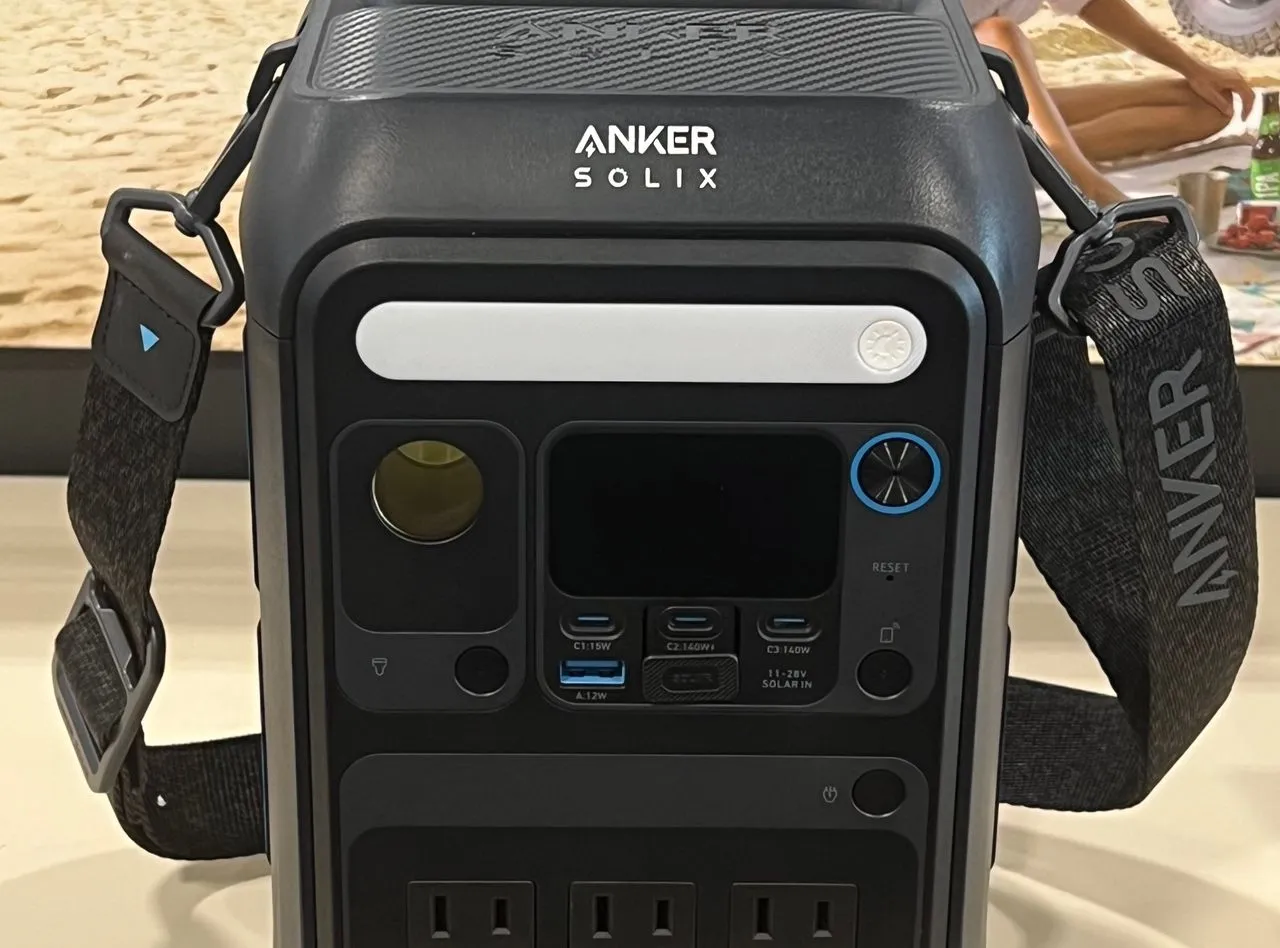
Cover photo: “Anker SOLIX C300X Portable Power Station” by TaurusEmerald, via Wikimedia Commons, licensed under CC BY-SA 4.0.
Frequently asked questions
Is the EcoFlow DELTA 3 the same thing as the DELTA 3 Plus?
No, and most comparison sites online get this wrong. The base DELTA 3 is a fixed 1,024Wh unit at 1,800W output. The DELTA 3 Plus is a separate, pricier model with its own spec sheet. This article compares the base DELTA 3 — EcoFlow's direct answer to the Jackery Explorer 1000 v2 — against listings that quietly swap in the Plus's numbers.
Does the Jackery Explorer 1000 v2 have a UPS mode?
Yes. Jackery's own spec sheet lists a bypass mode with roughly 20-millisecond switchover — enough to keep a fridge or router from noticing a blip. It is real UPS functionality, just not as fast as the EcoFlow DELTA 3's sub-10-millisecond switchover, which is the gap that actually separates these two units.
Which charges faster, the Jackery Explorer 1000 v2 or the EcoFlow DELTA 3?
The DELTA 3, by a wide margin. EcoFlow's X-Stream charging takes it from empty to full in 56 minutes on a standard 1,500W AC input. The Jackery needs about 1.6 hours on the same kind of outlet, or roughly an hour if you switch on its app-controlled Emergency Charging mode first.
Can either power station be expanded with an extra battery?
Only the EcoFlow DELTA 3. EcoFlow sells a compatible extra battery that takes the system to 5kWh total, and the same battery is shared across several DELTA models. The Jackery Explorer 1000 v2 is a fixed 1,070Wh unit with no official expansion path — what you buy is what you get.
Which is better for running a refrigerator during an outage?
Either one handles the job: both carry 3,000W-plus surge ratings, several times what a fridge compressor needs to start. The DELTA 3 edges ahead because its faster UPS switchover and pass-through mean the fridge can stay plugged in full-time without you remembering to act when the power drops.
Is the EcoFlow DELTA 3 worth paying more for than the Jackery Explorer 1000 v2?
If you want the fastest possible recharge, room to expand later, and the tightest UPS switchover, yes. If you mainly need a grab-and-go battery that also happens to cover a fridge overnight, the lighter, usually cheaper Jackery does the same core job without those extras.